
Landscape Lighting Installation for Hillside and Desert Yards
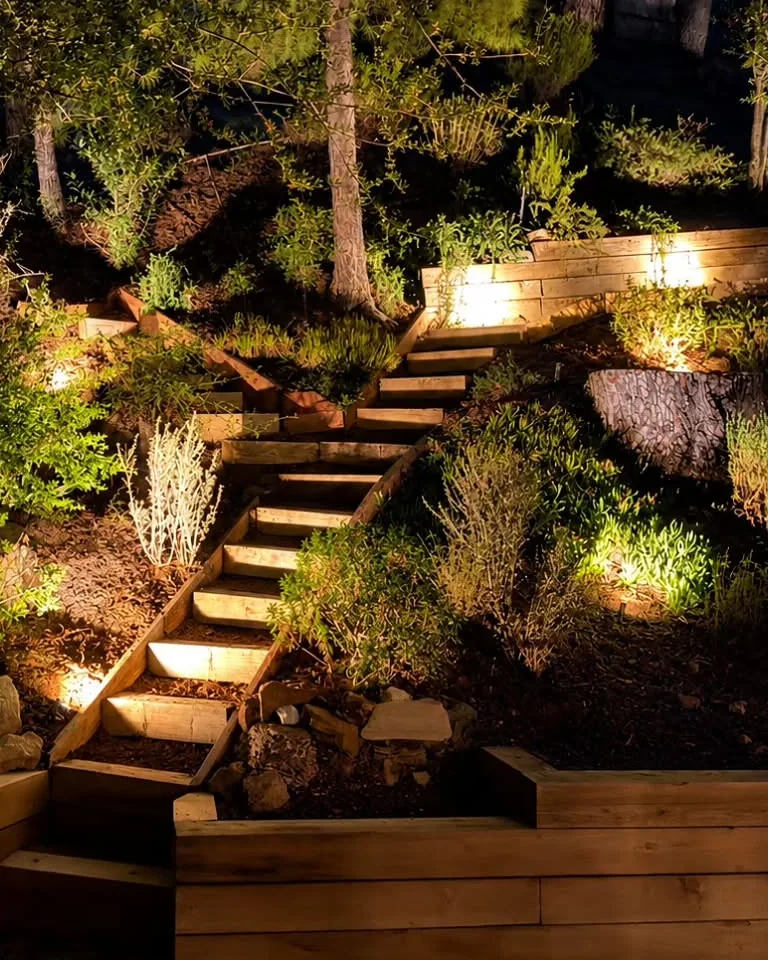
Most yards disappear the minute the sun goes down. On a flat lot that’s mostly a shame: all that planting, and you only enjoy it by daylight. On a hillside it’s a safety problem too, because steps, slopes, and retaining walls become hard to see. Good landscape lighting fixes both at once. This fall we lit a terraced hillside yard in Agoura Hills from the timber stairs all the way to the back fence, and the photos in this guide come from that job.
Below: how the two kinds of systems work, which fixtures do what, how to lay out a yard, what changes on a slope or in the high desert, and where a licensed electrician comes in.
Low-Voltage vs. Line-Voltage Landscape Lighting
Landscape lighting comes in two basic types, and the difference is how much voltage reaches the fixtures.
Low-voltage systems use a transformer to step your home’s 120-volt power down to a much lower voltage, usually 12 volts, before it goes out to the yard. Because the voltage is low, the cable is lighter and fixtures are easy to move as plants grow. Paired with LED fixtures, it’s the most common choice for home landscapes.
Line-voltage systems run full 120-volt household power to each fixture. That means heavier wiring in conduit or rated direct-burial cable, buried deeper, with weatherproof boxes at the connections. Line voltage makes sense for powerful floodlights, very long runs, or permanent fixtures on a larger property, and it’s always a job for an electrician.
Which one fits depends on how big the yard is, how far the fixtures sit from the house, how bright you want things, and whether you expect to rearrange the planting later. We walk the yard and talk it through with you before anything gets ordered.
The Transformer, and Why Its Outlet Matters
On a low-voltage system, the transformer is the heart of the setup. It mounts outside near the house, takes in 120 volts, and sends low-voltage power out along the cable runs. Many have a built-in timer or a connection for a dusk sensor.
Two things decide whether it works well:
- Sizing and voltage drop. The transformer has to be sized for the total wattage of the fixtures, with room to add more later. Voltage also drops along long cable runs, so the farthest fixtures on a big lot can come out dimmer than the rest unless the runs are planned for it.
- A proper outlet. The transformer needs an outdoor outlet with GFCI protection (the kind that shuts off if current leaks to ground), a weather-resistant receptacle, and a weatherproof “in-use” cover that stays closed while the plug is in. The circuit behind it needs room for the load, too.
That outlet is where a lot of DIY kits go wrong. If there’s no outdoor outlet where the transformer should go, the answer is to add one, not to run an extension cord out from the garage. Adding a weather-rated outdoor outlet, or a dedicated circuit when the yard needs its own power, is squarely the electrician’s part of the job.
Fixture Types and Where Each One Works
You don’t need a dozen fixture styles. Most good designs lean on three.
Path and step lights. Short fixtures that throw light down and out across walkways, stairs, and bed edges. Step lights can also mount along the sides of the stairs themselves. These are the safety lights, and they go in first.
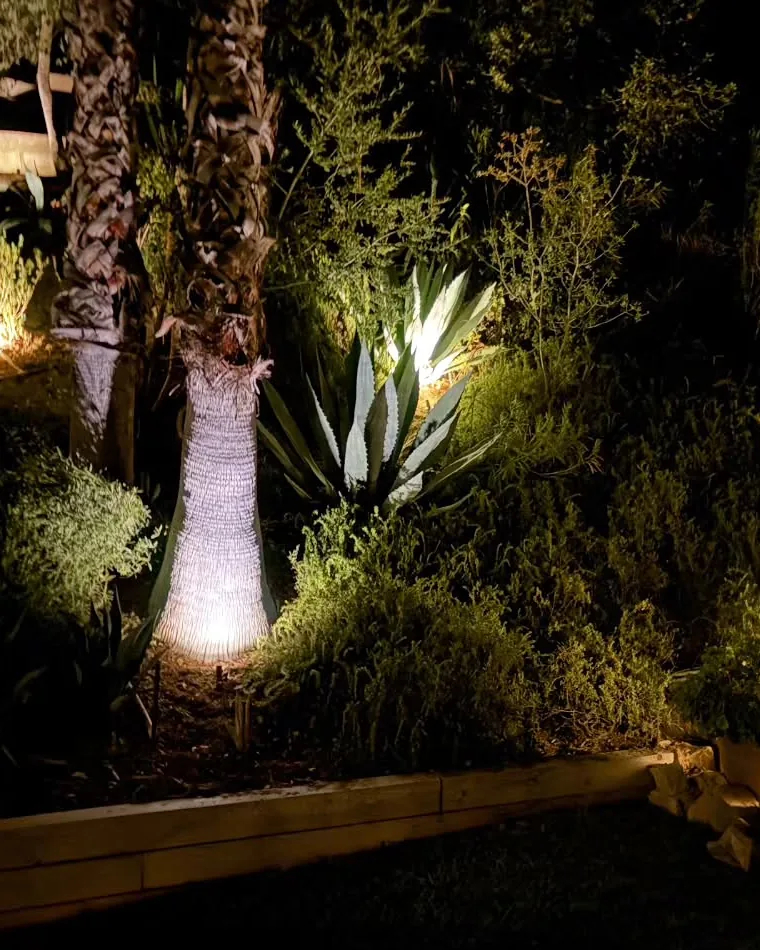
Uplights. A fixture at the base of a tree, aimed up the trunk into the canopy. One light can make a palm trunk glow from the ground up; a wide tree may need two, from different sides. Uplights also work on a single showpiece plant, like a big agave.
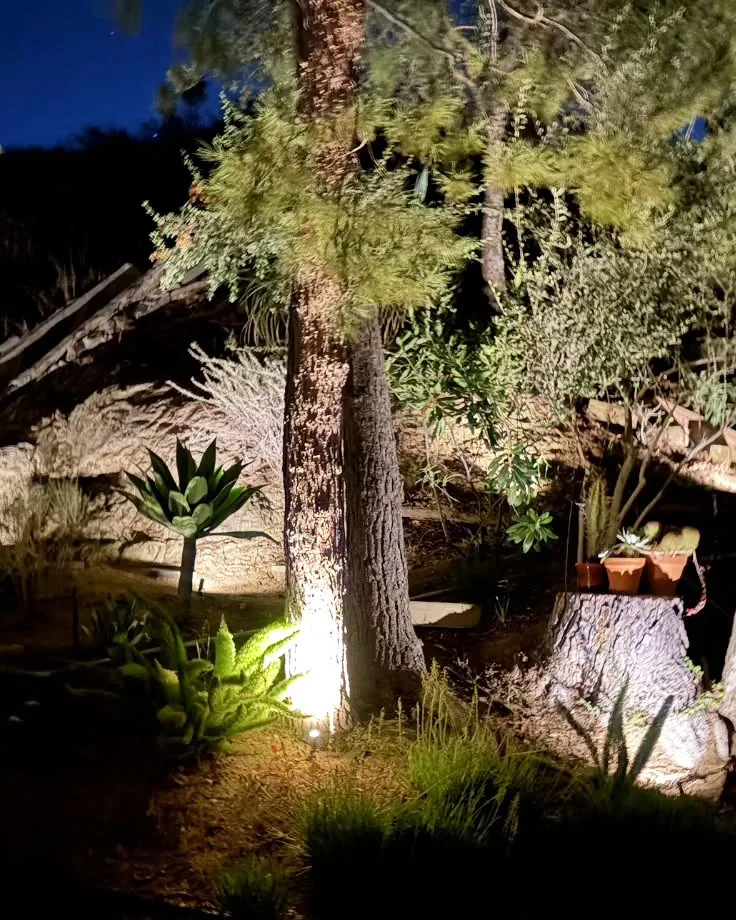
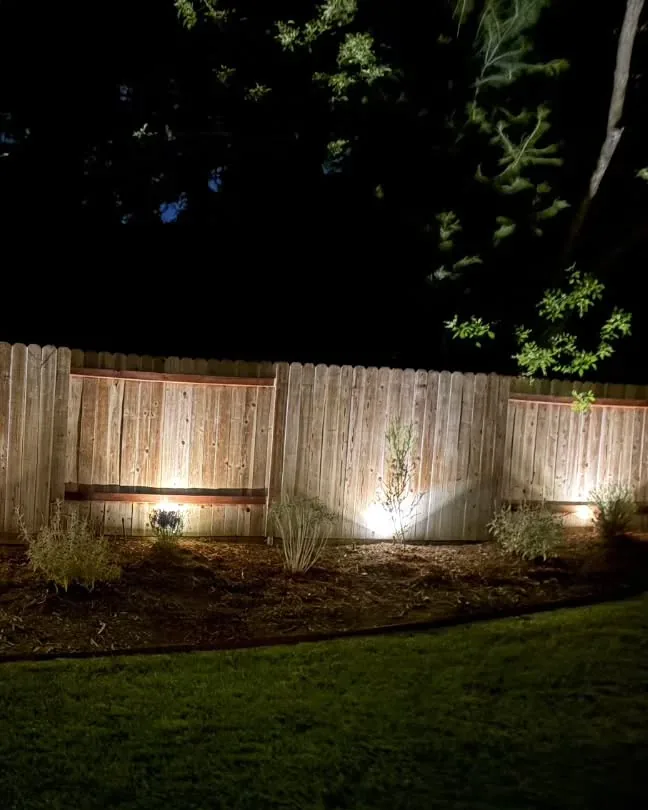
Wall-wash lights. A wide, soft beam spread across a fence, garden wall, or retaining wall. Washing a vertical surface brightens the whole space around it without pointing a bright fixture at anyone, and set close to the surface it brings out texture like wood grain or stone.
Photocell, Timer, or Both
Nobody wants to switch landscape lights on by hand every evening. The usual options:
- Photocell: a light sensor that turns the system on at dusk and off at dawn. Mount it where a porch light or passing headlights won’t fool it.
- Timer: turns the lights on and off at set times. An astronomical timer follows the changing sunset through the year on its own.
- Both: a common setup is on at dusk by photocell, off at a set hour by timer, so the yard isn’t lit all night.
If you’d rather control the lights from your phone or tie them into the rest of the house, smart switches and other smart-home controls can handle that.
Layout Tips: Safety First, Then the Showpieces
- Light where people walk. Stairs, paths, the gate, the side yard, and anywhere the ground changes level. On a slope, every step and transition should be easy to see.
- Then pick a few features. A specimen tree, a wall, a fence line. Lighting everything evenly flattens the yard; contrast is what makes it look good.
- Kill the glare. Aim fixtures away from eyes, windows, seating areas, and the neighbors’ houses. Choose shielded fixtures, keep path lights low, and never aim an uplight where someone on the patio or in an upstairs room looks straight into it.
- Check it at night before calling it done. Fixture aim always gets fine-tuned after dark. A few degrees can turn a harsh hot spot into an even glow.
Hillside and High-Desert Yards: What’s Different
Southern California is hard on outdoor equipment, and slopes and desert sun add problems of their own.
Sun and UV. In the high desert around Lancaster and Palmdale, summer sun bakes plastic fixtures and cable jackets until they turn brittle. Metal fixtures (brass, copper, or powder-coated aluminum) and UV-resistant, outdoor-rated cable hold up much better. Where you can, keep the transformer out of all-day direct sun.
Wind. Antelope Valley wind finds anything loose. Stake fixtures firmly, skip tall, flimsy path lights in exposed spots, and keep cable buried so it can’t get pulled up or whipped around. Dust settles on lenses, so plan to wipe them down now and then.
Slopes. Rain and irrigation wash soil downhill, and cable buried too shallow on a slope can end up exposed. Run cable along the terraces and retaining walls rather than straight down the hill, protect it where it crosses steps or wall caps, and keep fixtures out of drainage paths. On a terraced yard like the one in Agoura Hills, the retaining walls themselves are natural places to set lights.
Burying wire safely. Call 811 before anyone digs, so underground utility lines get marked. Keep landscape cable clear of irrigation lines, bury it deep enough that shovels and edgers won’t find it, and use the burial method that matches the voltage; line-voltage wiring has stricter depth and conduit rules than low-voltage cable. Snap a few photos of the cable route before it’s covered, so you know where it runs the next time you plant.
Why a Licensed Electrician Matters for the Power Side
The low-voltage fixtures in a flower bed aren’t the risky part. Everything upstream of the transformer is 120-volt household power: the outdoor GFCI outlet, the circuit feeding it, a hardwired transformer, a switch inside the house, and any line-voltage fixture. That’s where a mistake becomes a shock hazard or an overloaded circuit, and it needs to be done to code.
A licensed electrician makes sure the circuit has room for the load, the outdoor outlet and cover are rated for wet locations, the transformer is sized and placed right, and anything line-voltage is wired and buried correctly. We plan the layout and controls with you, install the system, then aim and adjust the fixtures so the light lands where you want it. In Agoura Hills, the result is uplights on the trees, lights along the stairs and retaining walls, wash lights across the back fence, and stairs that are safe to walk at night. Swipe through the full set of photos on our projects page, or see everything else on our lighting installation page.
Ready to Light Up Your Yard?
If you’re planning landscape lighting, or you already have a kit and no good place to plug it in, start with the power side. Genius Electric Corp is a licensed, owner-operated electrician based in Lancaster, serving the Antelope Valley, the High Desert, Santa Clarita, and greater LA. We’ll walk your yard, talk through layout and controls, and give you a free, up-front estimate. Reach out through our contact page to get started.
Common questions
Can I install low-voltage landscape lighting myself?
The fixtures and low-voltage cable from a plug-in kit are within reach of a handy homeowner. The power side is different: the outdoor GFCI outlet, any new circuit, a hardwired transformer, and anything line-voltage are electrician work. If there's no proper outdoor outlet where the transformer needs to go, that's the part to hand off.
How many landscape lights does my yard need?
Usually fewer than people expect. Start with the stairs, paths, and level changes so the yard is safe to walk, then add uplights on one or two feature trees and a wash on a wall or fence. Contrast is what makes a lit yard look good; lighting every plant evenly tends to look flat and adds glare.
Can landscape lights turn on at dusk and off at a set time?
Yes. A photocell turns the system on when it gets dark, and a timer shuts it off at whatever hour you choose, so the yard isn't lit all night. Many transformers have these controls built in, or they can be added at the outlet or switch that feeds the system.
Can you add landscape lighting to a finished yard without tearing it up?
Usually, yes. Low-voltage cable can be run through planting beds and tucked along edges, walls, and terraces with minimal digging, and fixtures are staked in among the existing plants. We plan the cable routes around irrigation lines and established roots before anything goes in the ground.