
Tesla Wall Connector vs NEMA 14-50: Which Should You Install?

If you want Level 2 charging at home, the choice usually comes down to two setups: a hardwired Tesla Wall Connector, or a NEMA 14-50 outlet with a plug-in mobile connector. Both run on 240 volts, and we install both — a Wall Connector on the outside wall of a Palmdale home, a 14-50 in a Lancaster garage. Here’s an honest Tesla Wall Connector vs NEMA 14-50 comparison.
The two setups in plain English
Tesla Wall Connector: a charger wired directly to its own circuit. That’s what “hardwired” means — no plug; the wires land on terminals inside the unit, and the charging cable is permanently attached.
NEMA 14-50 outlet + mobile connector: “NEMA 14-50” is a specific 240-volt, 50-amp outlet, the same one used for RVs and some electric ranges. You plug a portable charger into it — for Tesla drivers, the Mobile Connector with its 14-50 adapter; other brands sell their own.
Charging speed: it comes down to amps
The voltage is the same for both. What changes is how many amps the charger can draw.
- NEMA 14-50: the outlet is rated 50 amps, but EV charging counts as a continuous load (it runs for hours), and code limits a continuous load to 80% of the circuit. So the most any charger can pull from a 14-50 is 40 amps.
- Tesla Mobile Connector: Tesla’s Gen 2 Mobile Connector tops out at 32 amps, even on a 14-50. Some other brands’ portable chargers are built to use up to the full 40.
- Tesla Wall Connector: the Gen 3 Wall Connector can deliver up to 48 amps on a 60-amp circuit — half again as much current as the Mobile Connector.
One catch: your car sets a ceiling too. Every EV’s onboard charger has its own maximum, and some models and trims can’t accept 48 amps no matter what’s on the wall.
For a lot of drivers, 32 amps is plenty, because the car sits most of the night anyway. A Wall Connector’s extra speed earns its keep with a long commute (the Antelope Valley-to-LA drive, say), two EVs sharing one charger, or short charging windows.
Flexibility and portability
The 14-50’s big advantage is that it doesn’t care what’s plugged into it. Switch EV brands, add a second car or sell the house, and the outlet still works; your portable charger goes with you.
The Wall Connector is fixed equipment, mounted and wired for good. In exchange you get a tidy cable holster, the highest charging speed, Wi-Fi for updates, and the option for two Wall Connectors to share one circuit using Tesla’s power-sharing feature.
Outlet wear: the 14-50’s weak spot
A 14-50 used for EV charging works harder than almost any other outlet in your home: up to 40 amps for hours, night after night. Every time a plug goes in and out — say, when the Mobile Connector rides along on road trips — the contacts inside loosen a little. A loose contact under that load makes heat, and heat at a connection is where trouble starts.
Two things help: a heavy-duty, industrial-grade receptacle like the one below, and leaving the home charger plugged in (keep a second cord for the trunk).


You can check this yourself: right after a long charging session, carefully touch the plug and cover plate. Warm is normal; hot is not. Discoloration, a melted look or a burning smell means stop using that outlet and have it looked at. A hardwired Wall Connector sidesteps all of this — there’s no plug contact to wear out.
GFCI: the code rule that changes things for outlets
A GFCI (ground-fault circuit interrupter) watches for current leaking out of a circuit — through water, damaged insulation or a person — and shuts the power off in a fraction of a second. Under the electrical code California uses today, a 240-volt receptacle in a garage or outdoors needs GFCI protection, and so does any receptacle installed for EV charging. For a new 14-50, that usually means a two-pole GFCI breaker in your panel.
It’s the right rule for safety, with a known side effect. EV chargers have their own ground-fault protection built in, and some chargers and GFCI breakers don’t get along: the breaker trips, and you walk out in the morning to a car that didn’t charge. Not every combination does it, but enough do that we talk it through before you choose.
A hardwired charger isn’t a receptacle, so it doesn’t need that separate GFCI breaker; its built-in protection does the job. For a charger that’s staying put, that alone is a good reason to hardwire.
Outdoor installs
Plenty of homes here park in the driveway, not the garage. That was the Palmdale job: we ran a correctly sized 240-volt circuit to the outside wall by the driveway, mounted the Wall Connector with the cable coiled tidy, and confirmed it was charging at full speed. A Wall Connector is built to mount indoors or out, with nothing to unplug or carry off.
A 14-50 can go outside too, but it needs a weather-resistant receptacle, a cover that stays weatherproof with the plug in, and the GFCI protection above — and a portable charger left plugged into an outside wall is easy to walk away with.
Not driving a Tesla?
Most non-Tesla EVs in North America have used the J1772 plug, while Teslas use Tesla’s own connector (often called NACS, now standardized as SAE J3400). More automakers are moving to Tesla’s style of port, but plenty of cars still have J1772.
That’s where the 14-50 shines: any portable charger with a 14-50 plug works, whatever the brand. A standard Wall Connector has a Tesla plug, so a J1772 car needs an adapter — though Tesla also sells J1772 and universal versions, and other brands make hardwired J1772 chargers. Two EVs of different brands at home? Tell us before the wire is run.
Your panel decides what’s possible
A Wall Connector at full speed needs a 60-amp circuit; a 14-50 needs a 50-amp circuit. On a 100-amp panel already carrying central air, a dryer and a range, that may simply not fit. You have options:
- Size the circuit to what you have. A Wall Connector can be set up for a smaller breaker and charge at a lower rate, which is often still enough overnight.
- Manage the load. A load-management setup can let the charger share capacity with other big appliances.
- Upgrade. Sometimes a panel upgrade is the honest answer. In Simi Valley, the old exterior meter-main was rusted and failing, so we set a new main-breaker panel and meter, then ran EMT conduit through the garage to a hardwired Level 2 charger.
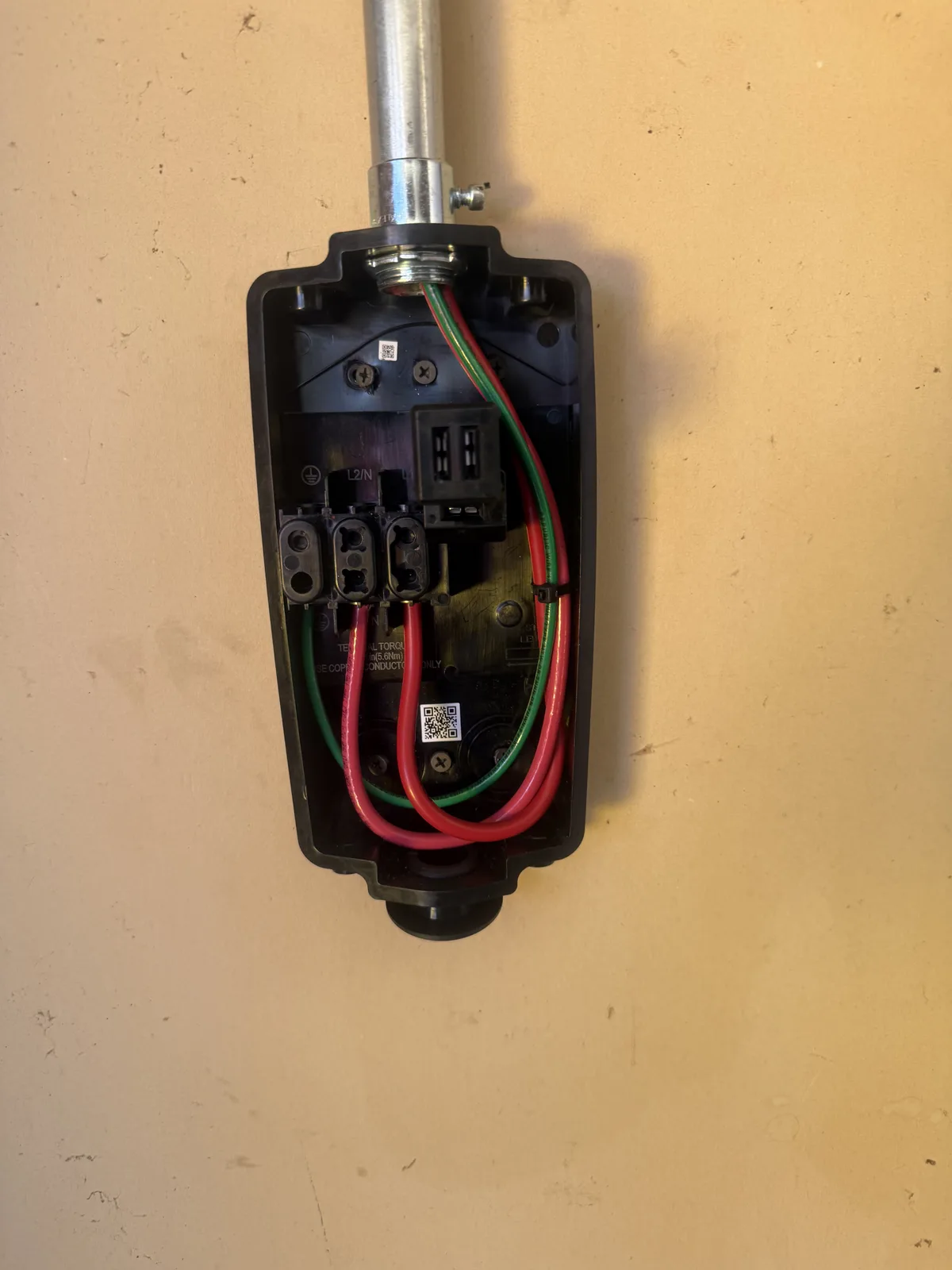
If you’re an SCE customer, the Charge Ready Home program can help qualifying households pay toward a 200-amp panel upgrade and the dedicated charger circuit — our EV rebates page explains how to apply.
So which one should you pick?
Lean toward a Wall Connector if you drive a Tesla, you’re staying put, you park outside, you want the fastest charging your car can take, or you’d rather skip the GFCI-breaker question entirely.
Lean toward a 14-50 if you want brand flexibility, you already own a portable charger you like, you may move before long, or you’d like an outlet an RV can use too.
When to call an electrician
Picking the charger is your call; installing either one is not a DIY job. Both mean a new 240-volt circuit from your panel, a permit and an inspection, and the details — wire size, breaker type, GFCI — are where problems hide. We’ll look at your panel and parking spot, tell you honestly what fits, and quote it free and up front. Get in touch through our contact page — we install both setups across Lancaster, Palmdale and the rest of our service area.
Common questions
Does a NEMA 14-50 outlet for EV charging need a GFCI?
On a new install in a garage or outdoors, yes — the electrical code California uses today requires GFCI protection there, and on any receptacle installed for EV charging. That usually means a two-pole GFCI breaker in the panel. Some chargers can nuisance-trip those breakers, which is one reason many people choose a hardwired charger instead.
Can I put in a 14-50 now and switch to a Wall Connector later?
Yes. Tell us up front and we can size the wire so the circuit can go up to 60 amps when you make the switch, without pulling new wire. A Wall Connector can also be set up to run on the existing 50-amp circuit at a somewhat lower charging rate.
Will a Tesla Wall Connector work with a non-Tesla EV?
A standard Wall Connector has Tesla's plug, so a car with a J1772 port needs an adapter. Tesla also sells J1772 and universal versions, and more automakers are moving to Tesla's style of port. If you have mixed brands at home, tell us before we install so the setup fits both cars.
Is a 14-50 outlet fast enough to charge overnight?
For many drivers, yes. A Tesla Mobile Connector draws up to 32 amps from a 14-50, and the car is usually parked for most of the night. If you have a long daily commute, share one charger between two EVs, or need quicker top-ups, a Wall Connector's higher output — up to 48 amps on a 60-amp circuit, if your car can accept it — makes a real difference.